
A non-sectarian, citation-backed guide to early Buddhism.
Ask anything about practice or doctrine. Get grounded answers with tappable citations to the early suttas — so you can verify it for yourself. Designed for curious beginners and skeptical empiricists, with enough depth for committed practitioners.
Free daily practice, always. Support plans available if you're able.

Not a creed. A method.
You don't have to swallow anything on faith — just give it enough trust to run the experiment.
What practitioners say
Real words from the people using it.
“I love the idea and have even been able to use this for personal breakthroughs already.”
“An all comprehensive, detailed, thorough app as well as making the Dharma fun and engaging. The developers have thoughtfully made Buddhism relevant and engaging.”
“Exceptional app! The teachings & practices are for anyone who wants to improve their lives.”
“Excellent resource for exploring the Dharma!”
Field guide
Find the pattern before it runs the day.
A public guide to everyday dukkha: anger before the reply, craving the reset button, criticism spoiling the day, and other ordinary places practice begins.
Anger and resentment
Anger before reply
The flash between feeling hurt and trying to make the other person feel it too.
Anger and resentment
Resentment replay
The mind keeps returning to an old offense, each pass making the grievance feel newly alive.
Craving and avoidance
Craving a reset
The pull toward food, scrolling, shopping, sex, or fantasy when the present moment feels insufficient.
The core loop: learn, ask, reinforce, sit, return.
BuddhaUR is built around a repeatable daily rhythm:
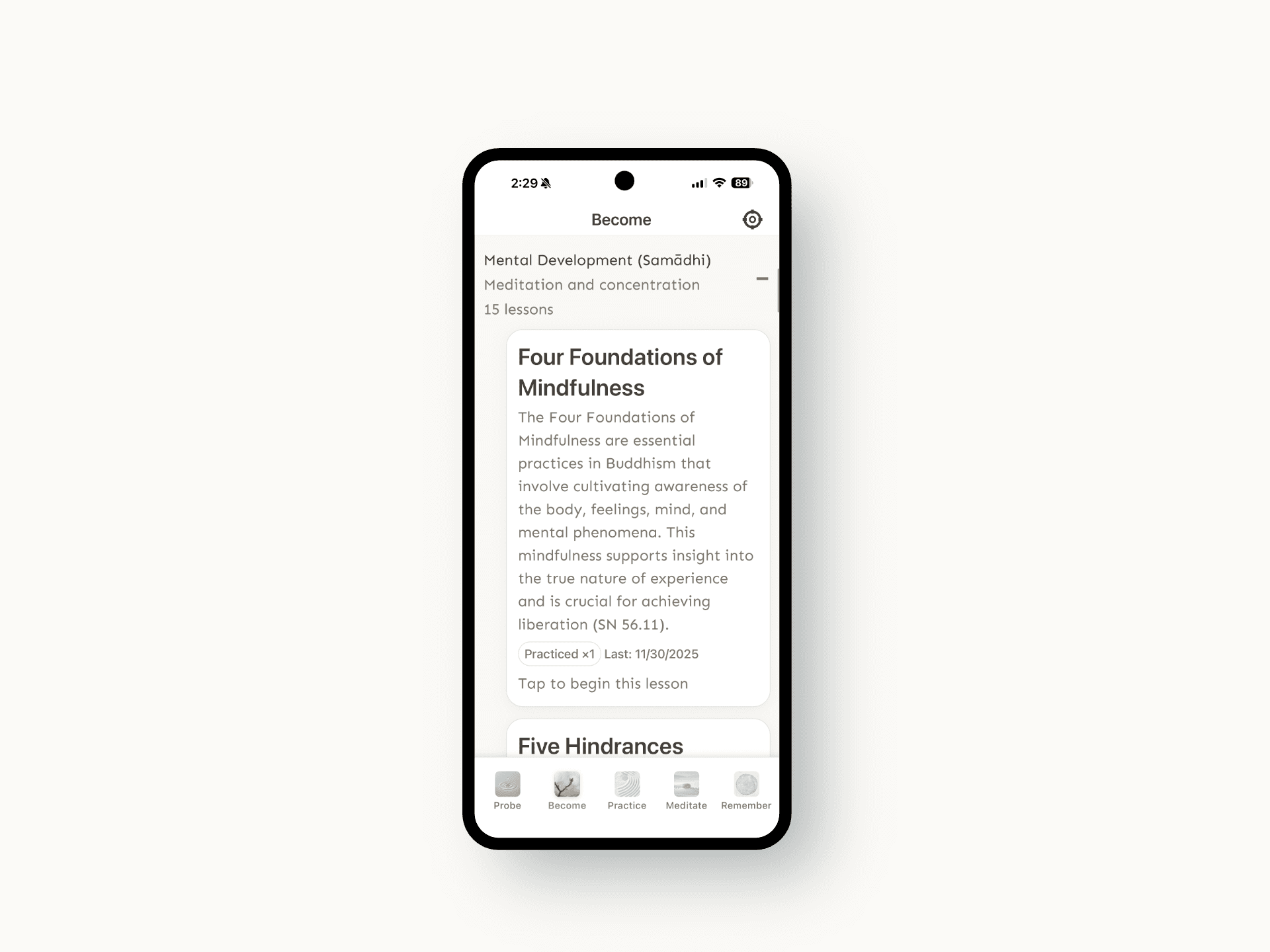
- 1Learna topic through one of 47+ guided lessons
- 2Askfollow-up questions in chat — Socratic style, not a generic chatbot
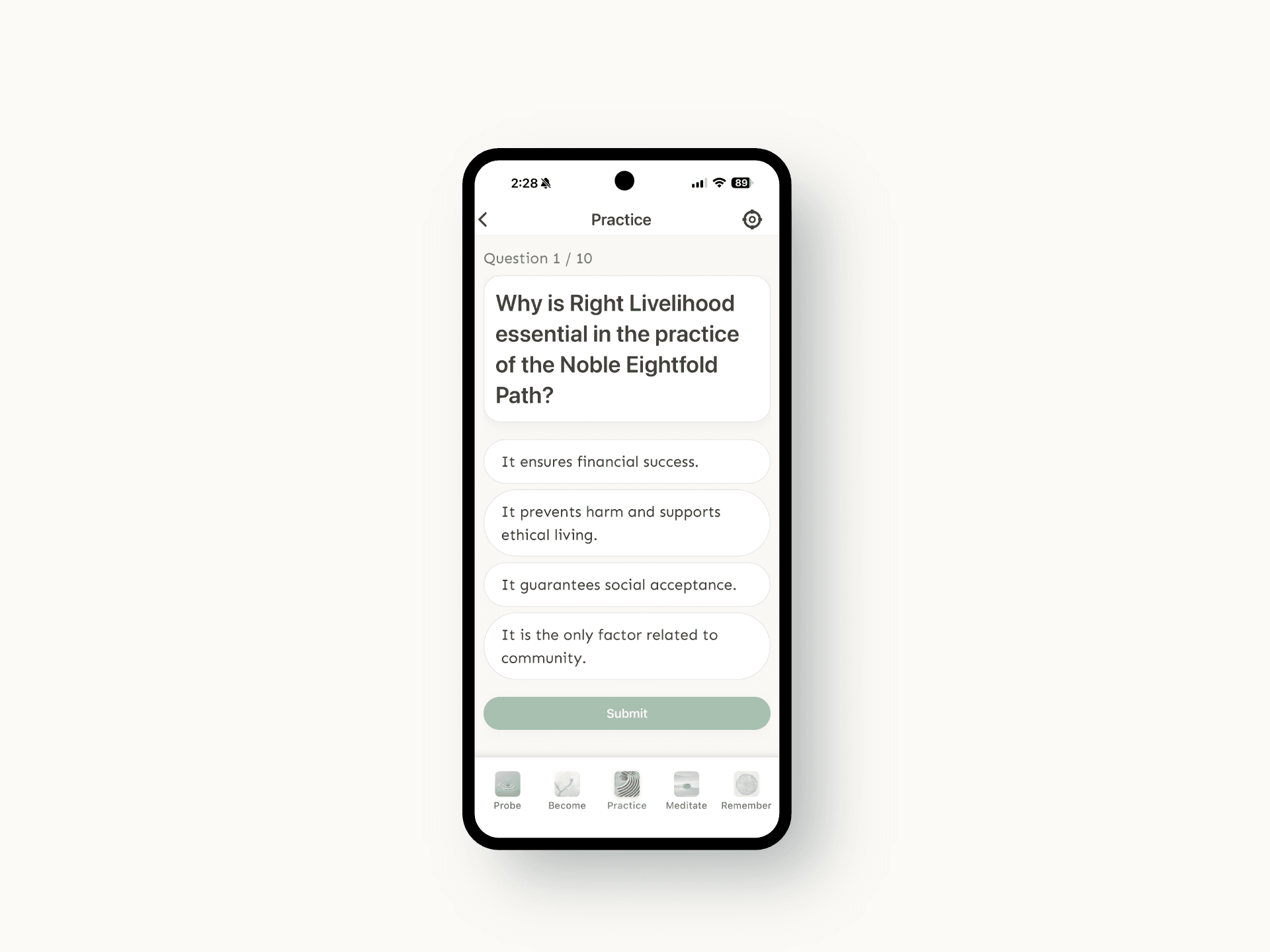
- 3Reinforcewith quizzes and adaptive practice that finds your weak spots
- 4Sitwith a calm timer, jot reflection notes, then "chat about this session"
- 5Returnwith a personalized Daily Dhamma talk each morning and a streak that tracks your rhythm
Core features
A teacher you can talk to
"What exactly are the Five Aggregates?" "How does Right Speech play out at work?" "What's a practical way to meet restlessness in meditation?" Ask anything — answers cite the relevant suttas so you can read them yourself.
Citations you can tap
Every answer is grounded in the earliest Buddhist texts. Tap inline citations to verify — links go straight to Bhikkhu Sujato's translations on SuttaCentral. Transparent scholarship, not hand-wavy magic.
Daily Dhamma talk
A personalized teaching each morning based on your journey — your lesson history, quiz topics, and conversations. 1-15 minutes, saved to history.
47+ guided lessons
Learn in arcs, not fragments. Lessons cover essentials from the Four Noble Truths to Nibbana, plus 9 dedicated meditation lessons. Each can branch into story, metaphor, or drill-down questions.
Quizzes + adaptive practice
Turn "I read it" into "I know it." Adaptive practice finds the topics you miss and brings them back at the right difficulty. Efficient, honest, and surprisingly motivating.
Meditation timer + reflection
A calm timer with gong or vibration alerts. Jot reflection notes, then "chat about this session." Your notes feed a private memory that helps the teacher remember what you're working on.
See it in action
A quick tour across lessons, quizzes, meditation, and more.



See the shape of the teachings.
Four Noble Truths. Eightfold Path. Five Aggregates. Five Hindrances. Seven Factors of Enlightenment. Dependent Origination. Three Characteristics. These "numbered frameworks" interlock in ways that aren't obvious until you see them together. BuddhaUR lets you browse them as an interactive visual map, so the relationships start to click.
Everything is free. Support the work if you're able.
Free for everyone
- Unlimited lessons and quizzes
- Unlimited conversations with the suttas
- Daily Dhamma talks
- Meditation timer and guided practices
- Conversation history + streaks
- Adaptive practice recommendations
- No limits, no gates
$5/month · $40/year · $100 lifetime
Your support keeps the servers running and the teachings accessible to everyone. Supporters help sustain a community of practice.
All features are free for everyone. The goal is access, not gatekeeping.
FAQ
Full FAQ
From David Kooi
I built BuddhaUR for the same reason I've built most things: I wanted to understand what was true.
My background is unapologetically rational — mathematician, statistician, student of cognitive science, raised on materialist philosophy. I came at the world with calipers and a hypothesis, and for a long time that was enough.
When I discovered that Robert Wright — a sober evolutionary thinker — wrote Why Buddhism Is True, the empiricist in me did a double-take. So I did what felt necessary: a 10-day silent Vipassana retreat to see whether the claims matched the phenomenology.
What I found wasn't a creed. It was a method. You don't have to swallow anything on faith — just give it enough trust to run the experiment.
BuddhaUR is my attempt to put the earliest sources in your hand, help you see the "numbered frameworks" as a coherent map, and invite you to test the claims in the lab of your own attention.
"You give it enough trust to run the experiment."